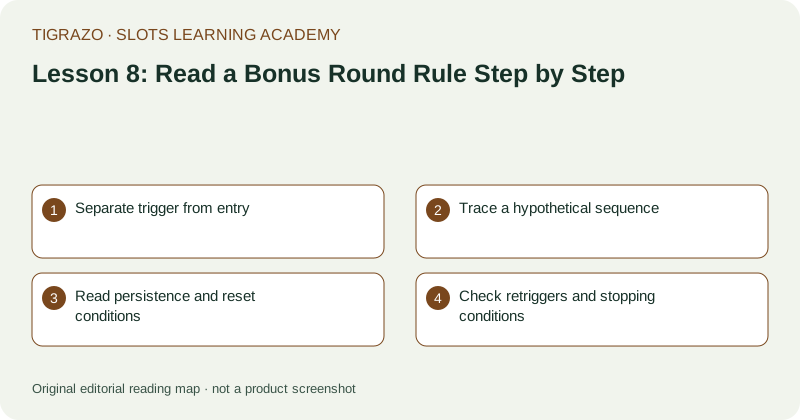
Separate trigger from entry
Start with the exact trigger condition: symbol count, eligible positions, mode and any required stake configuration. A trigger may award a feature directly or lead to a selection stage. Record the number of initial rounds or actions and whether a triggering spin also pays a separate award. Do not assume that a symbol called a scatter always performs both functions. Its payout and its triggering role may follow different rules, including different minimum counts, positions or substitution restrictions.
Trace a hypothetical sequence
Suppose a hypothetical feature begins with six free spins and a multiplier of one. Its rule says the multiplier increases by one after each winning free spin. If the first free spin pays a base award of 2.00 currency units, its multiplier is still one, so it pays 2.00. The next free spin begins at multiplier two. Increasing the first award immediately would misread the word after. This example illustrates timing only; it does not describe any particular game's feature or expected results.
Read persistence and reset conditions
Determine which changes persist between feature rounds. A sticky wild may remain for one round, several rounds or the entire feature, depending on the rule. A multiplier may reset after a non-winning round or remain unchanged. Reel expansion might be permanent only until the feature ends. Put these conditions in a simple chronological list. Whenever the text says remains, resets or next, attach the phrase to a specific event. That prevents a persistent-looking animation from being treated as a rule.
Check retriggers and stopping conditions
Find whether additional rounds can be awarded, which symbols cause them and whether the same trigger applies inside the feature. A retrigger can award a different number of rounds from the initial trigger. There may also be a maximum number of rounds or a game-award cap that ends the feature. Read how unused rounds and accumulated awards are handled when such a limit is reached. More rounds are not a guarantee of more payment, and the existence of a feature does not establish its average value.
Knowledge check
For the hypothetical multiplier rule, what applies after a non-winning round? The example does not say, so the correct response is to seek that missing rule rather than invent a reset. Build a five-part summary: trigger, starting state, changes during play, retrigger conditions and settlement. Then explain one sample feature in chronological order without promotional language. If your explanation requires phrases such as probably or usually, mark the underlying point as unresolved and return to the information panel before treating the summary as complete.