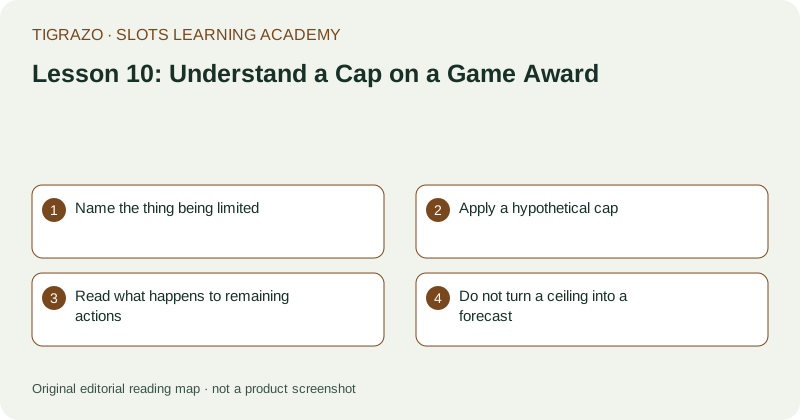
Name the thing being limited
Look for whether the limit applies to one spin, one feature, a combined game round or another defined unit. A maximum bet is a different restriction, and a displayed jackpot amount may follow separate conditions. A cap expressed as a multiple of stake needs a clear stake basis. Do not silently substitute line stake for total stake or assume every award type contributes to the same ceiling. The surrounding rule should explain scope, aggregation and any exceptions that affect how the limit operates.
Apply a hypothetical cap
Imagine a hypothetical game with a combined round cap of one thousand times total stake. At a stake of 0.20 currency units, that cap equals 200.00. Suppose uncapped calculations would produce 215.00 within that defined round. If the rule clips the combined award at the cap, the paid amount is 200.00, not 215.00. This example assumes that precise clipping rule. Some games describe different handling, so the arithmetic must never be used to invent settlement conditions that the text does not establish.
Read what happens to remaining actions
A feature may stop when its maximum award is reached, even if a counter still shows unused rounds. Another rule might handle the remaining sequence differently. Find the sentence addressing termination rather than assuming every awarded free spin will always be played. Also check whether a single large sub-award is limited independently before it enters a combined total. Order can matter: limiting separate components and limiting their sum are not necessarily equivalent. A short worked timeline can make that distinction easier to understand.
Do not turn a ceiling into a forecast
The maximum communicates a boundary, not a probability distribution. It does not disclose how often awards approach that boundary or what most sessions return. Two games with equal caps can have very different RTP, hit frequency and volatility. A hypothetical currency conversion can clarify scale, but it should not be presented as an expected opportunity. Similarly, the fact that earlier rounds paid little does not move an independent future round closer to its cap. Past losses create no entitlement to a larger result.
Knowledge check
A hypothetical cap of five hundred times a 0.40 total stake equals 200.00. Does that establish a 200.00 jackpot? No: a cap and a jackpot are different concepts. Does it prove a feature continues until that amount is reached? No: the limit is not a target. Finish your rule summary with four entries: capped unit, multiplier basis, awards included and stopping behaviour. Leave any undocumented exception unresolved. A complete interpretation depends on all four entries, not merely the largest number shown on screen.