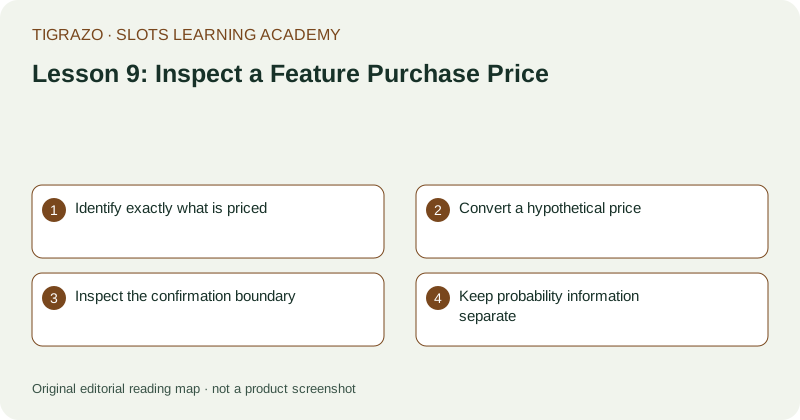
Identify exactly what is priced
A purchase option may enter a bonus, activate a modified mode or provide a particular feature variant. Read the label and detailed conditions together. Do not assume every option enters the same feature seen through ordinary play. Initial rounds, multipliers, symbol arrangements or other conditions may differ. Also determine whether the displayed price is a final currency amount or a multiple of an underlying stake. The presence of a familiar feature name does not resolve those differences or establish its expected value.
Convert a hypothetical price
Suppose a hypothetical option costs eighty times a base stake of 0.25 currency units. Its purchase price is eighty times 0.25, or 20.00. That is the amount committed to the purchase under the example's rule, not the cost of eighty future ordinary spins. If the resulting feature pays 7.00, the transaction's net change is minus 13.00. If it pays zero, the full 20.00 is lost. Neither calculation predicts what a real purchase would return or recommends making one.
Inspect the confirmation boundary
Before any paid action, identify where the interface shows the chosen mode, underlying stake and final price. Determine whether selecting a tile merely opens details or immediately commits funds. A confirmation screen should be read as transaction information, not as decorative interruption. If the terms or amount are unclear, leave the action unconfirmed. Do not use a purchase as an experiment to discover how the control works. The rules and any available non-transactional explanation should answer that question without committing money.
Keep probability information separate
A higher purchase price does not by itself establish a better expected return, a lower risk or a larger typical award. Different feature variants can have different mathematical characteristics, and any RTP information must apply to the relevant mode. A maximum-win display supplies no missing average or probability. If the mode's information is absent, record it as unknown instead of borrowing the base game's figures. The correct reading of a price is narrower: it tells you the stated cost under the displayed configuration.
Knowledge check
A hypothetical option priced at sixty times a 0.10 stake costs 6.00. If the stake changes to 0.20 before confirmation, the same multiple becomes 12.00. Which number should appear in your summary? The final amount associated with the selected configuration. Finish by listing the purchased mode, base stake, multiplier, currency price, entry conditions and confirmation boundary. This is a reading exercise, not a buying checklist: understanding a transaction does not create a reason to take it or make its outcome predictable.