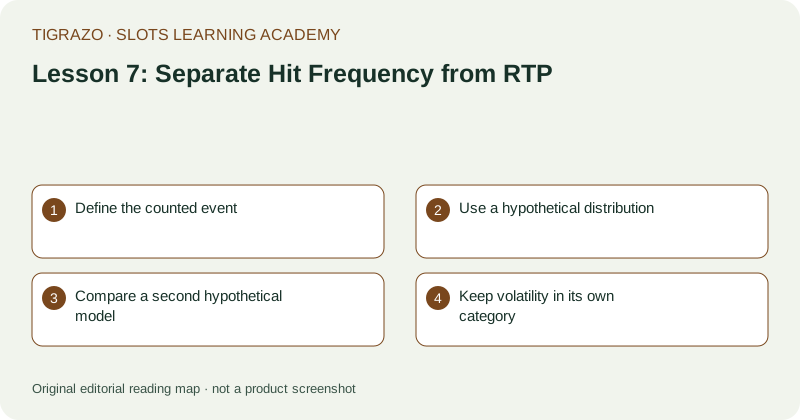
Define the counted event
Hit frequency usually refers to the proportion of spins that produce a qualifying award, but the exact definition matters. A published figure might count any payout, only certain awards or a particular feature event. Read that definition before using the number. A payout smaller than the stake may count as a hit even though the round reduces the balance. Consequently, a high frequency of displayed awards does not automatically mean frequent net gains. The size of each award remains essential to the financial picture.
Use a hypothetical distribution
Consider a simplified hypothetical model with a 1.00 stake. Half of outcomes pay 0.50, and half pay zero. The hit frequency, counting any positive payout, is 50 percent. Expected return is one half times 0.50 plus one half times zero, or 0.25 per 1.00 staked: a 25 percent RTP. This intentionally simple model is not a claim about an actual game. It demonstrates why counting awards without measuring their amounts cannot establish expected return.
Compare a second hypothetical model
Now imagine a different simplified model that pays 5.00 on one outcome in ten and zero otherwise, again for a 1.00 stake. Its hit frequency is 10 percent, while expected return is 0.10 times 5.00, or 0.50, giving a 50 percent RTP. It has fewer hits but a higher expected return than the first illustration. Neither model offers a prediction for a short sequence. Their purpose is to isolate the two concepts so that an attractive frequency label cannot stand in for return information.
Keep volatility in its own category
Volatility concerns the spread and concentration of outcomes rather than simply their frequency or average. Two games can share an RTP while distributing awards very differently. A frequent small payout pattern and a rare large payout pattern may produce the same mathematical mean. Without a documented definition or distribution, a volatility label provides limited precision. It should not be translated into a guaranteed waiting time, a likely session result or a claim that a large award must follow a quiet stretch.
Knowledge check
If a hypothetical spin costs 1.00 and pays 0.30, can it count as a hit? Yes, when hits include all positive payouts. Is it a net gain? No: the balance changes by minus 0.70. Can hit frequency alone reveal RTP? No: award sizes and their probabilities are also needed. In your notes, create separate fields for event definition, frequency, expected return and variability. Leaving a field unknown is more accurate than deriving it from a number that answers a different question.