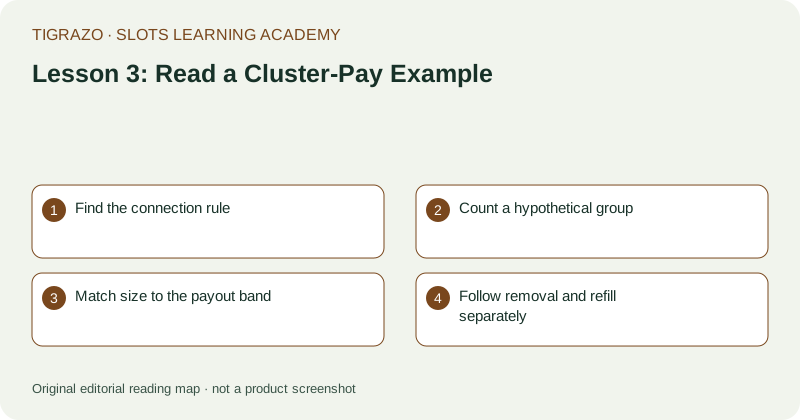
Find the connection rule
A cluster is a group defined by the game's connection rules, often using matching symbols that share horizontal or vertical edges. Diagonal contact may not qualify. Start by finding that definition rather than estimating a group from its visual closeness. Also locate the minimum group size and any restrictions on special symbols. Two identical symbols separated by a different symbol are not connected merely because they sit in the same row. An empty position or a blocked cell can also interrupt a possible connection.
Count a hypothetical group
For a hypothetical example, imagine four moons occupying a two-by-two square and a fifth moon immediately below its left column. With edge adjacency, all five belong to one group. A sixth moon touching only the outside corner is separate. If five symbols meet the minimum, the first group qualifies while the isolated moon does not. If diagonal adjacency were permitted, the answer could change. The purpose of drawing the grid is to apply a written rule, not to replace it with intuition.
Match size to the payout band
Find the row for the moon symbol and the column or range covering five connected symbols. Some paytables show exact sizes; others group sizes into bands such as five through seven. Check whether larger groups receive one band award or a separate amount per symbol. In a hypothetical rule paying six times total stake for a qualifying five-symbol moon group, a stake of 0.20 currency units gives 1.20. That arithmetic applies only to this stated multiplier and stake basis, not every cluster game.
Follow removal and refill separately
If winning symbols disappear and new ones enter, treat the next evaluation as another stage in the same documented process. Record the initial group, its award, any multiplier change, the removal and the refill. New symbols may form a fresh qualifying group, but an animation does not guarantee another award. Check whether multipliers increase before evaluation or afterward and when they reset. These timing details can change the amount even when the visible group size remains unchanged between two otherwise similar examples.
Knowledge check
Would five matching symbols scattered across the grid necessarily form one cluster? No: they must satisfy connectivity as well as size. Would two groups of three automatically become a qualifying group of six? No: their connection and any aggregation rule matter. For your final exercise, sketch a small grid and circle connected groups without assigning money. Only after that, consult the hypothetical paytable. Keeping identification and valuation separate makes it easier to spot whether an error came from geometry or arithmetic.