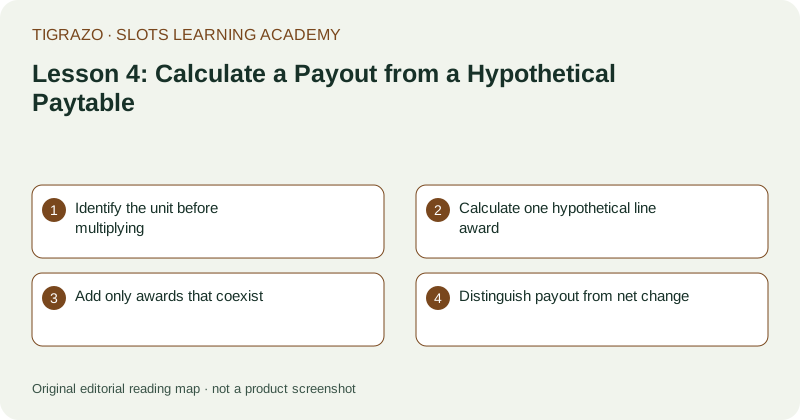
Identify the unit before multiplying
Read the paytable heading and the surrounding explanation. If an entry says twenty, determine whether that means twenty currency units, twenty coins or twenty times a specified stake. Also check whether displayed amounts update when the stake changes. A responsive display may already show a currency award, in which case multiplying by the stake again would count the stake twice. Write the unit beside every copied number. This simple habit prevents a correct multiplication from producing an incorrect interpretation of the result.
Calculate one hypothetical line award
Assume a hypothetical game has ten equally staked active lines and a total spin stake of 1.00 currency unit. The line stake is therefore 0.10. Suppose four matching bells pay twenty times the line stake. The award for that qualifying line is twenty times 0.10, which equals 2.00 currency units. Using the total stake instead would incorrectly produce 20.00. The difference is not a rounding problem: it comes from multiplying by the wrong base. Keep the total stake and line stake in separate columns.
Add only awards that coexist
Suppose a second qualifying line pays five times its 0.10 line stake, producing 0.50. If the rules allow both line awards together, their combined payout is 2.50. Do not additionally count the three-bell award contained inside the four-bell match unless the payment rule requires it. Likewise, a scatter or feature award should be added only according to its own settlement conditions. A visible collection of potential matches is not automatically a list of independently payable items that can all be summed.
Distinguish payout from net change
In this hypothetical spin, a 2.50 payout against a 1.00 stake produces a net balance increase of 1.50, ignoring any unrelated adjustments. The payout is still 2.50; it should not be relabelled as profit. If the payout were 0.40 against the same stake, the net change would be minus 0.60 even though an award appeared. Use consistent language when comparing the paytable, round summary and balance movement. Each describes a different part of the transaction, and none should silently replace another.
Knowledge check
A hypothetical award of twelve times a 0.05 line stake equals 0.60. An award of twelve times a 0.50 total stake equals 6.00. Explain why the identical multiplier gives different results. Then audit your own calculation in this order: qualifying result, payout entry, stake basis, applicable multiplier, permitted aggregation and currency conversion. If a rule remains unknown, show the calculation as conditional. Numerical precision cannot compensate for an assumption about which award the game actually pays.