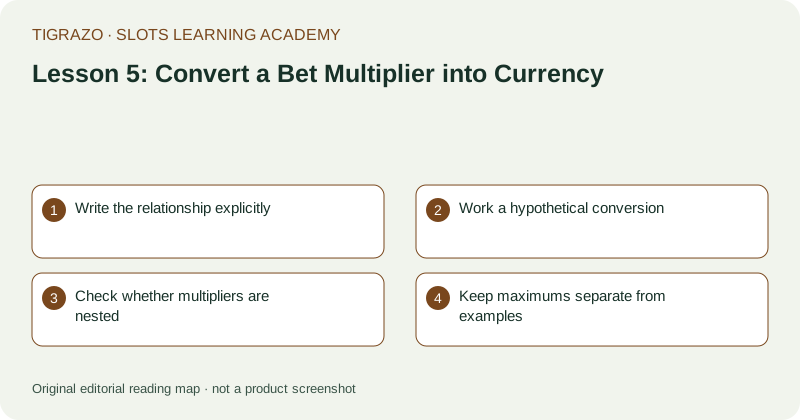
Write the relationship explicitly
If an award is expressed as a multiple of total stake, the conversion is award equals multiplier times total stake. Keep both values from the same configuration and round. If the rule instead refers to line stake, coin value or another base, use that base rather than importing the total-stake formula. The letter x beside a number is only shorthand. It does not explain whether the amount includes other awards, whether a feature multiplier is already included, or whether a cap can limit payment.
Work a hypothetical conversion
Suppose a hypothetical result pays thirty-five times a total stake of 0.40 currency units. Multiplying thirty-five by 0.40 gives a payout of 14.00. If the stake for that round was deducted separately, its net balance effect is 14.00 minus 0.40, or an increase of 13.60. At a hypothetical stake of 0.10, the same thirty-five-times award would be 3.50. This shows how the currency amount scales mathematically; it does not suggest changing a stake or predict another result.
Check whether multipliers are nested
Suppose an information panel says a result worth eight times total stake receives a three-times feature multiplier. If the rules apply that multiplier to the whole result, the final award is twenty-four times total stake. But a summary already displaying twenty-four times may include the feature multiplier. Multiplying it by three again would be an error. Read the order of operations and look for words such as final, combined or before multiplier. If several multipliers appear, confirm whether the game adds, multiplies or selectively applies them.
Keep maximums separate from examples
An advertised maximum expressed as a stake multiple describes an upper limit under specified conditions. It does not state how frequently that limit occurs or establish a typical return. Currency conversion can show what that number means at a particular hypothetical stake, but it cannot provide missing probability information. Also distinguish a maximum award from a maximum stake: one limits a result, while the other limits the amount committed. Confusing these labels can turn a simple comparison into an inaccurate account of both cost and potential payment.
Knowledge check
A hypothetical 7.5-times total-stake award at 0.20 pays 1.50 currency units. If the stake is deducted separately, the net change is plus 1.30. Explain each unit in that statement and identify what it does not reveal: the result's probability, future outcomes and the session's eventual balance. Before accepting any multiplier calculation, ask what is multiplied, whether the shown figure is already final, and which rounding or cap rules apply. Those checks are more useful than memorising isolated payout numbers.